Neutralisation and Gas Tests

Neutralisation reactions, carbonate and oxide reactions, and the hydrogen, oxygen and carbon dioxide tests.

Original JD Science GCSE Chemistry lesson. Captions are available in the player.

Neutralisation reactions, carbonate and oxide reactions, and the hydrogen, oxygen and carbon dioxide tests.

Download Neutralisation and Gas Tests (MP4)

More GCSE Chemistry topics

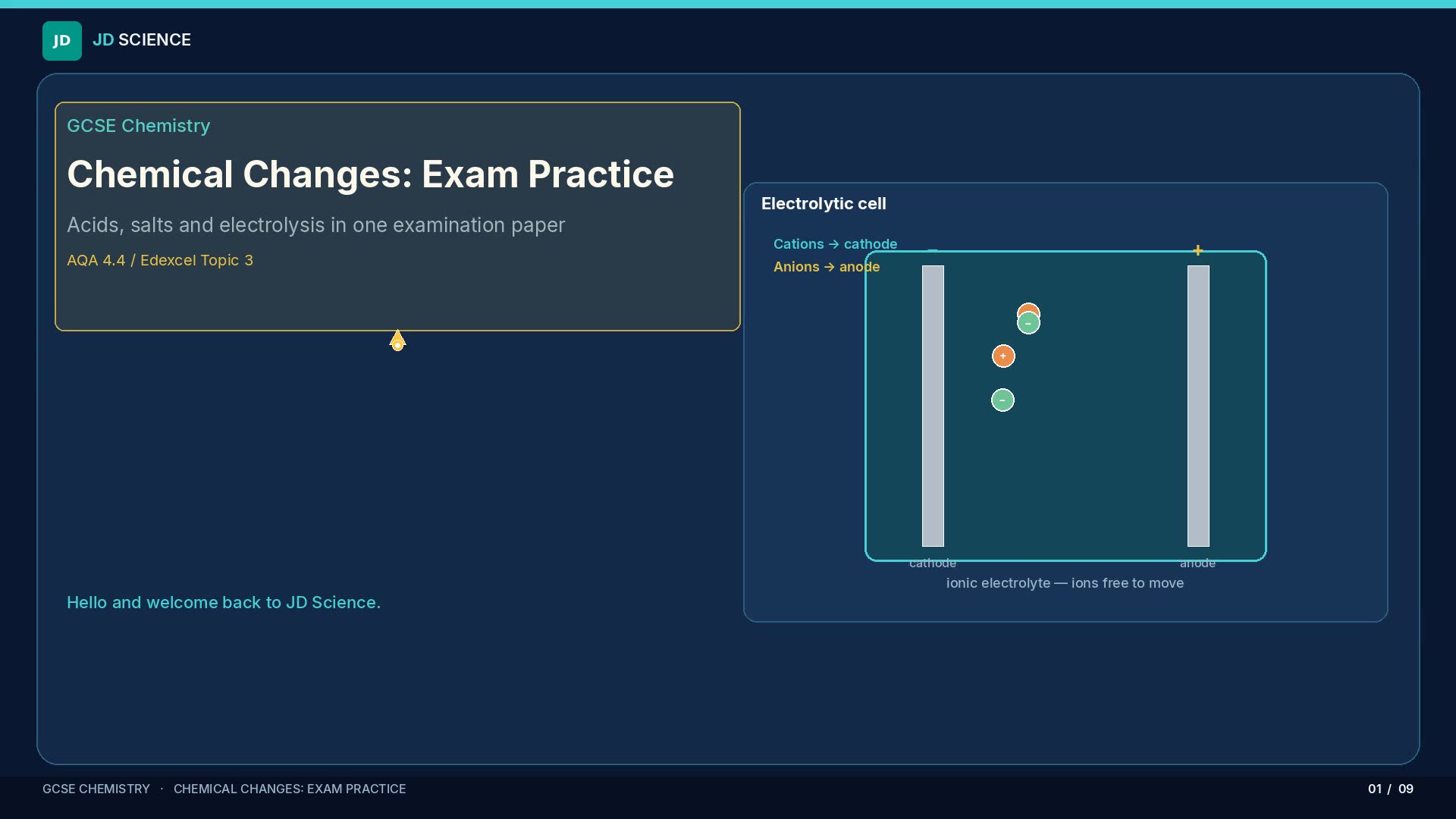
States of MatterParticle arrangement and movement in solids, liquids and gases, with exam-style questions.Changes of StateMelting, boiling, evaporation and condensation, including an accurate heating curve.Pure Substances and MixturesHow melting points show purity, and how mixtures differ from pure substances.Separation TechniquesFiltration, crystallisation, simple distillation and fractional distillation.ChromatographyPaper chromatography, Rf values and why different dyes separate.Potable Water and Waste Water TreatmentPotable water, sewage treatment and why desalination can be expensive.Acids, Bases and AlkalisAcids, bases and alkalis, including hydrogen ions, hydroxide ions and why not every base is an alkali.Indicators and the pH ScaleLitmus, universal indicator and the pH scale, including how pH links to hydrogen ion concentration.Strong and Weak AcidsHigher Tier: strong and weak acids, ionisation, and why strength is not the same as concentration.Acids Reacting with MetalsMetal-acid reactions, the hydrogen test, reactivity, and Higher Tier redox half-equations.Making Soluble and Insoluble SaltsHow to make soluble salts by crystallisation and insoluble salts by precipitation, with solubility rules.Acid-Alkali TitrationTitration apparatus and method, concordant titres, and calculating unknown concentration.Electrolysis: Ions and ElectrodesWhat an electrolyte is, how ions move, and what happens at the anode and cathode.Electrolysis of Molten Ionic CompoundsElectrolysis of molten ionic compounds, including lead bromide and aluminium extraction ideas.Electrolysis of Aqueous SolutionsRules for aqueous electrolysis, including hydrogen versus metal at the cathode and halide versus oxygen at the anode.Copper Purification by ElectrolysisPurifying copper by electrolysis, including electrode reactions, sludge and why the electrolyte stays blue.Chemical Changes: Exam PracticeSynoptic GCSE practice covering acids, salt-making, titration ideas and electrolysis rules.Calculating MolesHow to calculate moles from mass and relative formula mass, with worked examples and a practice question.ConcentrationConcentration in mol/dm³ from moles and volume, with unit conversions and a practice question.Percentage by MassPercentage by mass from an element's Ar and the compound's Mr, with worked examples and a practice question.Empirical FormulaeFinding an empirical formula from percentage composition, including dividing by Ar and simplifying the ratio.Atom EconomyAtom economy from the Mr of the desired product and the total Mr of all products, with a practice question.